 Add to Chrome
 Add to Firefox
 Add to Edge
Plan Before Search: Search Agents Need Plan
May 27, 2026
Training large language models as retrieval-augmented reasoning agents typically combines reinforcement learning with an SFT cold start distilled from a stronger model. However, this paradigm overlooks two fundamental factors: the dependency structure among sub-skills, and the possibility that distillation is not the only route to capability acquisition. We study this through Plan, a structured agentic behavior for multi-hop retrieval that decomposes a question into ordered sub-questions before any retrieval is performed, so that each search step can be anchored to a pre-designed sub-question instead of drifting under the influence of partially relevant documents retrieved earlier. However, across three model families spanning 3B to 14B parameters, we find that an identical reward signal induces qualitatively different RL failure modes. This phenomenon indicates that successful training hinges not only on reward design but also on model-specific feasibility conditions: sufficient initial entropy, training stability, and prerequisite sub-skills. Motivated by this, we propose a self-bootstrapping paradigm in which a small-scale seed model generates filtered trajectories that activate Plan in any target model, eliminating the need for distillation from an external stronger model. Our pipeline activates Plan across every tested model and consistently outperforms competitive baselines on multi-hop QA benchmarks.

Search-E1: Self-Distillation Drives Self-Evolution in Search-Augmented Reasoning
May 21, 2026Post-training has become the dominant recipe for turning a language model into a competent search-augmented reasoning agent. A line of recent work pushes its performance further by adding elaborate machinery on top of this standard pipeline. These augmentations import external supervision from stronger external systems, attach auxiliary modules such as process reward models or retrospective critics, restructure the rollout itself with tree search or multi-stage curricula, or shape the reward with hand-crafted bonuses and penalties. Each addition delivers a measurable gain, but each also inflates the training pipeline and ties the recipe to resources or designs that may not always be available. We take a step back and ask whether any of this machinery is actually necessary, and propose Search-E1, a self-evolution method that lets a search-augmented agent improve through only vanilla GRPO interleaved with offline self-distillation (OFSD). After each GRPO round, the policy rolls out on its own training questions. A token-level forward KL objective then aligns the policy's inference-time distribution to its own distribution under a privileged context that exposes a more efficient sibling trajectory. Despite this simplicity, the procedure naturally provides dense per-step supervision. On seven QA benchmarks, Search-E1 reaches $0.440$ average EM with Qwen2.5-3B, surpassing all open-source baselines at both scales. Code and complete version will be made public soon.
SD-Search: On-Policy Hindsight Self-Distillation for Search-Augmented Reasoning
May 18, 2026Search-augmented reasoning agents interleave internal reasoning with calls to an external retriever, and their performance relies on the quality of each issued query. However, under outcome-reward reinforcement learning, every search decision in a rollout shares the same trajectory-level reward, leaving individual queries without step-specific credit. Recent process-supervision approaches address this gap by drawing step-level signals from outside the policy, relying either on a much larger teacher model, or on sub-question annotations produced by a stronger external system. In contrast, we propose SD-Search, which derives step-level supervision from the policy itself through on-policy hindsight self-distillation, requiring neither an external teacher nor additional annotations. In SD-Search, a single model plays two roles that differ only in conditioning: a student that sees only the context available at inference time, and a teacher that additionally conditions on a compact hindsight block summarizing the search queries and final outcomes of a group of rollouts sampled from the same question. Since the teacher knows how each rollout unfolded and which ones succeeded, its query distribution implicitly marks which decisions were worth making, and the student is trained to recover this behavior by minimizing the token-level Jensen--Shannon divergence to the teacher at search-query positions. This layers a dense, step-level signal on top of GRPO's coarse trajectory reward. Crucially, this signal is produced by the policy itself within the standard RL training loop, without external model inference, auxiliary annotation pipeline, or additional training stage.
IG-Search: Step-Level Information Gain Rewards for Search-Augmented Reasoning
Apr 16, 2026Reinforcement learning has emerged as an effective paradigm for training large language models to perform search-augmented reasoning. However, existing approaches rely on trajectory-level rewards that cannot distinguish precise search queries from vague or redundant ones within a rollout group, and collapse to a near-zero gradient signal whenever every sampled trajectory fails. In this paper, we propose IG-Search, a reinforcement learning framework that introduces a step-level reward based on Information Gain (IG). For each search step, IG measures how much the retrieved documents improve the model's confidence in the gold answer relative to a counterfactual baseline of random documents, thereby reflecting the effectiveness of the underlying search query. This signal is fed back to the corresponding search-query tokens via per-token advantage modulation in GRPO, enabling fine-grained, step-level credit assignment within a rollout. Unlike prior step-level methods that require either externally annotated intermediate supervision or shared environment states across trajectories, IG-Search derives its signals from the policy's own generation probabilities, requiring no intermediate annotations beyond standard question-answer pairs. Experiments on seven single-hop and multi-hop QA benchmarks demonstrate that IG-Search achieves an average EM of 0.430 with Qwen2.5-3B, outperforming the strongest trajectory-level baseline (MR-Search) by 1.6 points and the step-level method GiGPO by 0.9 points on average across benchmarks, with particularly pronounced gains on multi-hop reasoning tasks. Despite introducing a dense step-level signal, IG-Search adds only ~6.4% to per-step training wall-clock time over the trajectory-level baseline and leaves inference latency unchanged, while still providing a meaningful gradient signal even when every sampled trajectory answers incorrectly.
DDA-Net: Accurate TDD Channel Estimation via Deep Unfolding the Doppler-Delay-Angle Representation of Channel Signals
Apr 07, 2026In TDD massive MIMO systems, channel estimation under sparse frequency-hopping pilots is challenging: each snapshot captures only one narrow pilot block that hops across frequency, with tens of milliseconds between adjacent snapshots. Finite-window leakage and off-grid effects weaken the ideal Doppler-delay-angle (DDA) sparsity, limiting both classical sparse recovery and purely data-driven approaches lacking an explicit structured transform-domain model. We propose DDA-Net, a model-driven 3D deep unfolding network for joint multi-snapshot channel state reconstruction. DDA-Net unfolds an ADMM formulation with an exact closed-form data-consistency update that avoids tensor inversion, learns the prior via a lightweight Doppler-domain denoiser, and uses delay oversampling to reduce basis mismatch. On QuaDRiGa UMa-NLOS, DDA-Net improves NMSE over the best baseline by more than 5 dB at 10 dB SNR, and retains a lead of about 1.5 dB under zero-shot testing on 3GPP CDL-B channels at the same SNR. Ablation studies show that window-level 3D processing is necessary across scenarios, while Doppler parameterization adds in-distribution gains and recovers a clear lead under scenario shift after few-shot fine-tuning with only 20 target-domain samples. These results demonstrate that combining exact physical data consistency with a learned DDA-domain prior is an effective and sample-efficient approach to channel state acquisition under sparse frequency-hopping pilots.
OneSearch-V2: The Latent Reasoning Enhanced Self-distillation Generative Search Framework
Mar 25, 2026Generative Retrieval (GR) has emerged as a promising paradigm for modern search systems. Compared to multi-stage cascaded architecture, it offers advantages such as end-to-end joint optimization and high computational efficiency. OneSearch, as a representative industrial-scale deployed generative search framework, has brought significant commercial and operational benefits. However, its inadequate understanding of complex queries, inefficient exploitation of latent user intents, and overfitting to narrow historical preferences have limited its further performance improvement. To address these challenges, we propose \textbf{OneSearch-V2}, a latent reasoning enhanced self-distillation generative search framework. It contains three key innovations: (1) a thought-augmented complex query understanding module, which enables deep query understanding and overcomes the shallow semantic matching limitations of direct inference; (2) a reasoning-internalized self-distillation training pipeline, which uncovers users' potential yet precise e-commerce intentions beyond log-fitting through implicit in-context learning; (3) a behavior preference alignment optimization system, which mitigates reward hacking arising from the single conversion metric, and addresses personal preference via direct user feedback. Extensive offline evaluations demonstrate OneSearch-V2's strong query recognition and user profiling capabilities. Online A/B tests further validate its business effectiveness, yielding +3.98\% item CTR, +3.05\% buyer conversion rate, and +2.11\% order volume. Manual evaluation further confirms gains in search experience quality, with +1.65\% in page good rate and +1.37\% in query-item relevance. More importantly, OneSearch-V2 effectively mitigates common search system issues such as information bubbles and long-tail sparsity, without incurring additional inference costs or serving latency.
FAR-Drive: Frame-AutoRegressive Video Generation in Closed-Loop Autonomous Driving
Mar 16, 2026Despite rapid progress in autonomous driving, reliable training and evaluation of driving systems remain fundamentally constrained by the lack of scalable and interactive simulation environments. Recent generative video models achieve remarkable visual fidelity, yet most operate in open-loop settings and fail to support fine-grained frame-level interaction between agent actions and environment evolution. Building a learning-based closed-loop simulator for autonomous driving poses three major challenges: maintaining long-horizon temporal and cross-view consistency, mitigating autoregressive degradation under iterative self-conditioning, and satisfying low-latency inference constraints. In this work, we propose FAR-Drive, a frame-level autoregressive video generation framework for autonomous driving. We introduce a multi-view diffusion transformer with fine-grained structured control, enabling geometrically consistent multi-camera generation. To address long-horizon consistency and iterative degradation, we design a two-stage training strategy consisting of adaptive reference horizon conditioning and blend-forcing autoregressive training, which progressively improves consistency and robustness under self-conditioning. To meet low-latency interaction requirements, we further integrate system-level efficiency optimizations for inference acceleration. Experiments on the nuScenes dataset demonstrate that our method achieves state-of-the-art performance among existing closed-loop autonomous driving simulation approaches, while maintaining sub-second latency on a single GPU.
CSMCIR: CoT-Enhanced Symmetric Alignment with Memory Bank for Composed Image Retrieval
Jan 07, 2026Composed Image Retrieval (CIR) enables users to search for target images using both a reference image and manipulation text, offering substantial advantages over single-modality retrieval systems. However, existing CIR methods suffer from representation space fragmentation: queries and targets comprise heterogeneous modalities and are processed by distinct encoders, forcing models to bridge misaligned representation spaces only through post-hoc alignment, which fundamentally limits retrieval performance. This architectural asymmetry manifests as three distinct, well-separated clusters in the feature space, directly demonstrating how heterogeneous modalities create fundamentally misaligned representation spaces from initialization. In this work, we propose CSMCIR, a unified representation framework that achieves efficient query-target alignment through three synergistic components. First, we introduce a Multi-level Chain-of-Thought (MCoT) prompting strategy that guides Multimodal Large Language Models to generate discriminative, semantically compatible captions for target images, establishing modal symmetry. Building upon this, we design a symmetric dual-tower architecture where both query and target sides utilize the identical shared-parameter Q-Former for cross-modal encoding, ensuring consistent feature representations and further reducing the alignment gap. Finally, this architectural symmetry enables an entropy-based, temporally dynamic Memory Bank strategy that provides high-quality negative samples while maintaining consistency with the evolving model state. Extensive experiments on four benchmark datasets demonstrate that our CSMCIR achieves state-of-the-art performance with superior training efficiency. Comprehensive ablation studies further validate the effectiveness of each proposed component.
InfoGain-RAG: Boosting Retrieval-Augmented Generation via Document Information Gain-based Reranking and Filtering
Sep 16, 2025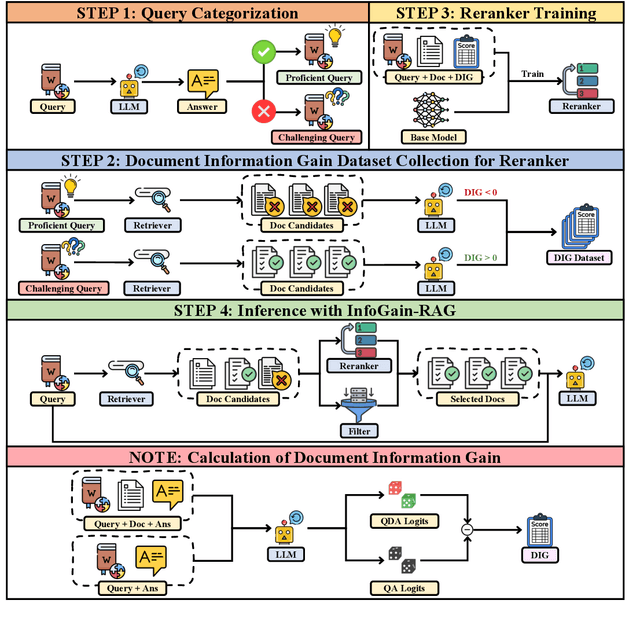
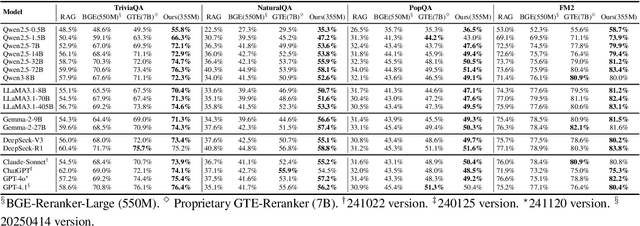
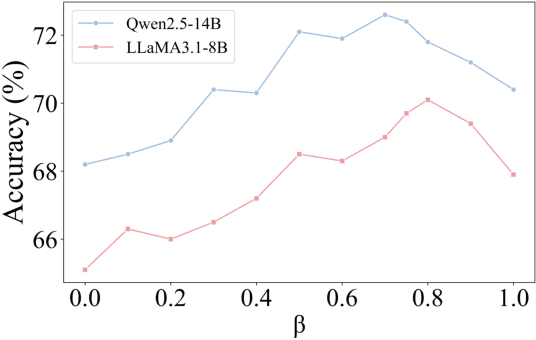
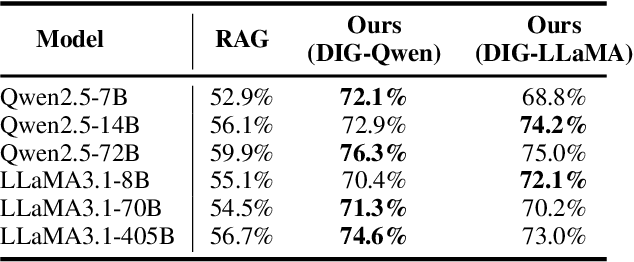
Retrieval-Augmented Generation (RAG) has emerged as a promising approach to address key limitations of Large Language Models (LLMs), such as hallucination, outdated knowledge, and lacking reference. However, current RAG frameworks often struggle with identifying whether retrieved documents meaningfully contribute to answer generation. This shortcoming makes it difficult to filter out irrelevant or even misleading content, which notably impacts the final performance. In this paper, we propose Document Information Gain (DIG), a novel metric designed to quantify the contribution of retrieved documents to correct answer generation. DIG measures a document's value by computing the difference of LLM's generation confidence with and without the document augmented. Further, we introduce InfoGain-RAG, a framework that leverages DIG scores to train a specialized reranker, which prioritizes each retrieved document from exact distinguishing and accurate sorting perspectives. This approach can effectively filter out irrelevant documents and select the most valuable ones for better answer generation. Extensive experiments across various models and benchmarks demonstrate that InfoGain-RAG can significantly outperform existing approaches, on both single and multiple retrievers paradigm. Specifically on NaturalQA, it achieves the improvements of 17.9%, 4.5%, 12.5% in exact match accuracy against naive RAG, self-reflective RAG and modern ranking-based RAG respectively, and even an average of 15.3% increment on advanced proprietary model GPT-4o across all datasets. These results demonstrate the feasibility of InfoGain-RAG as it can offer a reliable solution for RAG in multiple applications.
MoDULA: Mixture of Domain-Specific and Universal LoRA for Multi-Task Learning
Dec 10, 2024
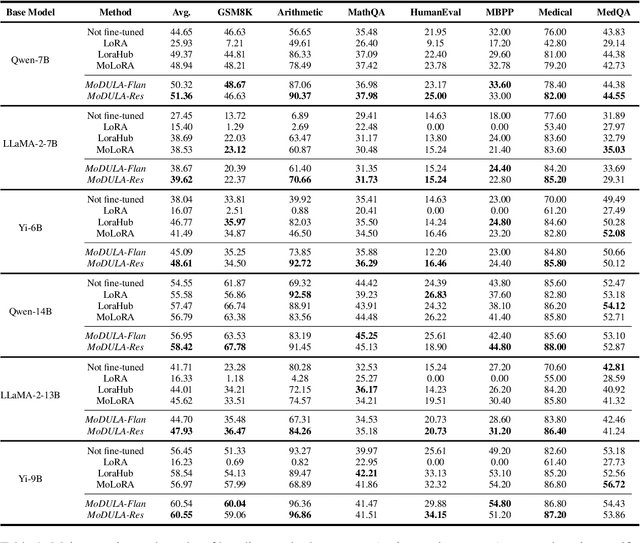


The growing demand for larger-scale models in the development of \textbf{L}arge \textbf{L}anguage \textbf{M}odels (LLMs) poses challenges for efficient training within limited computational resources. Traditional fine-tuning methods often exhibit instability in multi-task learning and rely heavily on extensive training resources. Here, we propose MoDULA (\textbf{M}ixture \textbf{o}f \textbf{D}omain-Specific and \textbf{U}niversal \textbf{L}oR\textbf{A}), a novel \textbf{P}arameter \textbf{E}fficient \textbf{F}ine-\textbf{T}uning (PEFT) \textbf{M}ixture-\textbf{o}f-\textbf{E}xpert (MoE) paradigm for improved fine-tuning and parameter efficiency in multi-task learning. The paradigm effectively improves the multi-task capability of the model by training universal experts, domain-specific experts, and routers separately. MoDULA-Res is a new method within the MoDULA paradigm, which maintains the model's general capability by connecting universal and task-specific experts through residual connections. The experimental results demonstrate that the overall performance of the MoDULA-Flan and MoDULA-Res methods surpasses that of existing fine-tuning methods on various LLMs. Notably, MoDULA-Res achieves more significant performance improvements in multiple tasks while reducing training costs by over 80\% without losing general capability. Moreover, MoDULA displays flexible pluggability, allowing for the efficient addition of new tasks without retraining existing experts from scratch. This progressive training paradigm circumvents data balancing issues, enhancing training efficiency and model stability. Overall, MoDULA provides a scalable, cost-effective solution for fine-tuning LLMs with enhanced parameter efficiency and generalization capability.